
Coast Region Travel Guide 2026: Why-What-Where-When to Visit

By Jonatan Chimarro ·
👋 Hello, I'm Jonatan
I'm a passionate tour guide in Ecuador and author of these blogs. I have lived and worked in all regions of Ecuador: Galapagos Islands, Amazon Rainforest, Andes Mountains and the coast. Quito is my birthplace. With over 10 years of work experience in tourism you can see me as your local expert. (Full bio at the end.)
This coast region travel guide is for anyone planning a tour. It is mainly for those traveling for the first time, but also if it is your third time. I write about the coast from what I see with my own eyes. I like to use infographics to make all the important information easy to understand. If you need more information, you are always welcome to contact me. There is also a comment section at the end of this blog in case of questions and suggestions.
⏱️ Coast in 1 minute
Ecuador's Pacific coast is a warm region filled with beaches, surf towns and fishing villages. Humpback whales pass offshore from June to September, and Isla de la Plata has Galapagos-style wildlife. Inland, the coast jungle is alive with exotic birds, monkeys and wildlife found nowhere else. The water stays warm all year. You pack light and take it slow. Here is the whole trip in five lines:
- Why go: Warm beaches, whale season, the Galapagos-style wildlife of Isla de la Plata, coast-jungle wildlife, fresh seafood and world-class surf.
- What to do: Watch humpback whales, snorkel Isla de la Plata, spot coast-jungle wildlife, eat ceviche, slow right down and swim and surf.
- When to go: Good all year. Warm, sunny mornings and short rain from December to May. Cooler and grayer from June to November, which is whale season.
- Where to go: A north-south beach strip: Puerto Lopez for whales, Montanita for surf, the quiet northern beaches, and Guayaquil as the city gateway.
- What it costs: Roughly USD 40 to 350 a day for your hotel, food and activities, with the beaches free.
1. Why visit the Pacific coast of Ecuador?
Come here to slow down, enjoy beach life and the tropical sun. Ecuador's coast is the country's warm to hot region. It is a long line of Pacific beaches, surf towns and fishing harbors. The sea is swimmable all year. Inland offers coast jungle with exotic wildlife. Enjoy this sunny climate with an exotic touch from the moment you arrive.
Why visit the Coast Region? Because it's hot! Hot in Galapagos experience, Amazon Rainforest experience and temperature. Ideal to relax and cool down.
— Jonatan Chimarro, Ecuador Travel Expert
The map is a simplified illustration of the whole pacific coast of Ecuador. The Pacific Ocean is on the left. The mainland of Ecuador is on the right. The dashed line crosses the infographic is the Equator. Sea and air stay warm here all year. The yearly average coast temperature is around 79°F (26°C). Pack light and enjoy the sun.
Reasons to visit the coast region of Ecuador are related to the beach of Puerto Lopez, Isla de la Plata and the coast region jungle.
Isla de la Plata is your Galapagos Islands experience. Here live the Waved Albatross, which only nests on this Island and Galapagos. Blue-footed birds and birds with inflatable red throats also live here. Snorkel with colorful fish and turtles. From June to September, you have the chance to spot whales.
The jungle of coast region is your Amazon Rainforest experience. This jungle has some of the highest biodiversity on Earth. The coast jungle is full of plants, frogs and exotic birds that live only here and nowhere else on earth.
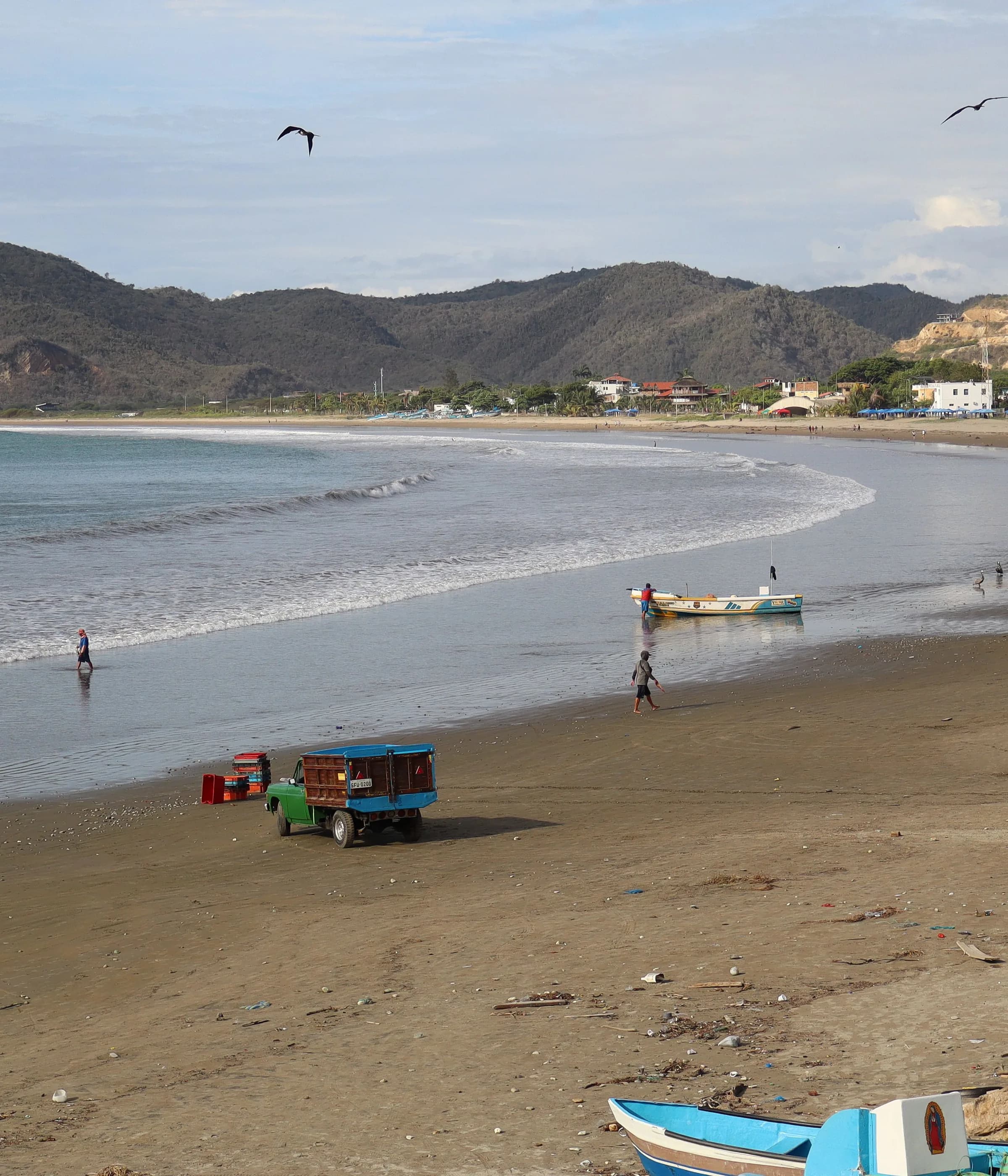
Relaxing on the beach of Puerto Lopez is your Pacific coast experience. Swim in the sea with the (near) perfect water temperature. Walk along the shore. Search sea shells. Relax on the beach. Enjoy local food at a restaurant.
2. What is the coast region of Ecuador?
Ecuador has four very different worlds, and this is the warm hot sea level region. The country's coast side connects to the Pacific ocean. It runs about 640 mi (1,030 km) from the Colombian border in the north down to Peru in the south. The coast line crosses 6 provinces: Esmeraldas, Manabi, Santa Elena, Guayas, El Oro and Los Rios. Guayaquil, the largest city in Ecuador, sits here too.
The easiest way to picture the coast is as a set of zones you cross as you move inland from the water. First comes the warm Pacific, swimmable all year. Then a long line of sandy beaches and surf. Behind them rise cliffs and rocky headlands that hide quiet coves. Where the rivers reach the sea you get tidal mangroves, alive with birds and crabs. A little further inland rises the coast jungle. This dense green strip is humid or dry. It is bursting with wildlife. The infographic below shows these five zones at a glance. This infographic is a simplified illustration to help you understand the environment. The real coast region can differ in detail, where certain zones can be limited or not existing while you travel throughout the coast region.
The coast from north to south can be divided into 3 sections. The quiet north, the whale-and-surf center, and the busy south around Guayaquil. The weather stays warm all year. Expect a hotter, sunnier wet season from December to May and a cooler, grayer season from June to November, which is also whale season.
3. What are popular travel locations in the coast region?
Think of the coast as one long road trip down the shore, from the empty beaches of the far north to the crowded beaches of the deep south. Most travelers pick a handful of stops rather than the whole line. The map below shows my top 7 beach towns plus the coast's best nature spots. Below the infographic I briefly explain each one.
Isla de la Plata offers unique wildlife. It is a perfect 1 day Galapagos experience. See blue boobies and frigate birds. Swim with colorful fish.
— Jonatan Chimarro, Ecuador Travel Expert
What each place is known for
Here is what each of the 7 beach towns is best known for. The numbers match the map above.
- 1. Puerto Lopez is the small fishing town that anchors whale season, and every whale tour in this guide leaves from here. It is the launch point for Isla de la Plata (a Galapagos-style experience for less time and money), the forest trails at Agua Blanca and San Sebastian, and the protected beach at Los Frailes.
- 2. Atacames is the north's party beach. A strip of bars sits right on the sand, mixing fresh-fruit cocktails, with salsa and dancing late into the night.
- 3. Mompiche is a small surf town where the jungle meets the sea. Come for the long point break, the black-sand beach just south, and Portete with the Isla del Amor sandbar you can walk to at low tide.
- 4. Canoa is a long surf beach below sandstone cliffs. The waves are steady and good for beginners, you can paraglide off the headland, and sea caves open up at low tide.
- 5. Manta is the coast's big fishing port and tuna capital. Stroll Playa Murcielago and its boardwalk, watch the catch come in before you eat ceviche, and find howler monkeys in the Pacoche forest just south.
- 6. Montanita is Ecuador's surf-and-party capital. It is famous for a right-hand point break, "Cocktail Alley" mixing drinks to order, and bars and clubs that run till dawn.
- 7. Salinas is Ecuador's biggest beach-resort town, out on the country's western tip. Its malecon links the Chipipe and San Lorenzo beaches, you can spot sea lions at La Chocolatera point, and whale tours run from June to September.
These are the coast's most popular stops. There are quieter beaches and fishing villages in between, but these give you the best of each stretch.
Nature and protected areas
The map's green markers are the coast's best nature and wildlife spots. The numbers match the green dots.
- 1. Isla de la Plata is a Galapagos-style wildlife experience for a fraction of the time and money, a day trip by boat from Puerto Lopez. Snorkel over reef fish and turtles, walk trails past blue-footed boobies and nesting frigatebirds, and from June to September watch for humpback whales on the crossing.
- 2. Coast Jungle is the green belt just inland, humid rainforest in the north and drier tropical forest in the south. It shelters monkeys, parrots and exotic birds found almost nowhere else.
- 3. Machalilla National Park is Ecuador's main coastal park, around Puerto Lopez. It protects the white-sand beach at Los Frailes, the Agua Blanca lagoon and museum, dry and humid forest, and Isla de la Plata offshore.
- 4. Isla Corazon is a heart-shaped mangrove island in the Chone estuary near Bahia de Caraquez. Canoe tours glide through mangrove tunnels to one of the Pacific's largest frigatebird colonies.
- 5. Pacoche forest is a wildlife refuge about 30 minutes south of Manta. Its misty coastal forest is famous for troops of howler monkeys, with boobies and hummingbirds along the trails.
- 6. Isla de los Pajaros sits off Puerto El Morro in the Gulf of Guayaquil, south of the city. Boat trips cross the mangroves to an island of thousands of frigatebirds, often passing bottlenose dolphins on the way.
4. Which wildlife will you see, and where?
Here is where I give the coast region the nickname, the "rich man's Galapagos." Island and jungle wildlife meet within easy reach of the beach, no cruise required. Save time and budget. You therefore leave Ecuador as a rich man.
The coast region combines Galapagos and Amazon wildlife in one place: sea turtles, seabirds and colorful fish offshore, plus monkeys and parrots in the jungle.
— Jonatan Chimarro, Ecuador Travel Expert
The headline act is the humpback whale. From June to September. Hundreds migrate up the warm current to breed and calve off Puerto Lopez. The whale-watching here is among the best in South America.
Nearby Puerto Lopez is the island Isla de la Plata. This island delivers a Galapagos-style wildlife experience. Ideal to save time and money. Blue-footed boobies do their comic courtship dance on the trails. frigatebirds puff their red throat pouches. This island is one of the only places outside the Galapagos where the waved albatross nests. The island is even home to a small bird found nowhere else on Earth — an endemic subspecies of Long-tailed Mockingbird. In the water you can snorkel with green sea turtles and colorful reef fish.
Offshore, sea turtles, dolphins and giant manta rays swim through the ocean. The coastal mangroves and coast jungle display their own birds and crabs. You can also hike through this jungle with a local guide. It is home to exotic animals more typical of the Amazon rainforest. Spot howler monkeys and parrots in the green dense jungle. It is a lot of wildlife for very little travel effort.
5. What are popular tourist activities in the coast region?
Most days here revolve around the water. Whether you want to meet a whale, relax on the sand or catch a wave, the coast region has it.
- Wildlife and birdwatching: boobies and albatross on Isla de la Plata (Puerto Lopez), howler monkeys in Manta's Pacoche forest, and sea lions at Salinas.
- Jungle and nature hikes: the forest trails behind Puerto Lopez, the Pacoche forest at Manta, and the green hills behind Mompiche.
- Snorkeling and diving: Isla de la Plata off Puerto Lopez, the Galera marine reserve near Mompiche, and dive trips from Manta and Salinas.
- Whale watching: boats run June to September from Puerto Lopez, the whale-watching capital.
- Surfing: the famous breaks of Montanita, Canoa and Mompiche, with gentler waves at Manta.
6. When to visit the coast region?
The coast has no truly bad season, but it has two very different moods. Your dates mostly come down to one question: do you want sun, or do you want whales?
The coast is worth visiting throughout the entire year. Any day is good. To pinpoint your preferred date use the tips for booking below.
December to May is the hotter, wetter season. Mornings are bright and sunny, the sea is at its warmest, and the hills turn green. There can be rain in the afternoon, but the beach days are the sunniest of the year.
June to November is cooler and drier. Less heat and more comfort. There is more mist that limits visibility. These months are therefore not optimal for taking pictures of the landscape.
Whale season is June to September. The whales are popular among tourists. Book in time, because boat spots are limited.
7. Examples of coast tours
To make it concrete, here are three tour shapes I run most often. Each strings the coast highlights together at a relaxed, beach-time pace.
Here is how the trip works. You go by car from Quito and return the same way, and every night you sleep in Puerto Lopez, so you unpack only once. These are the days in between.
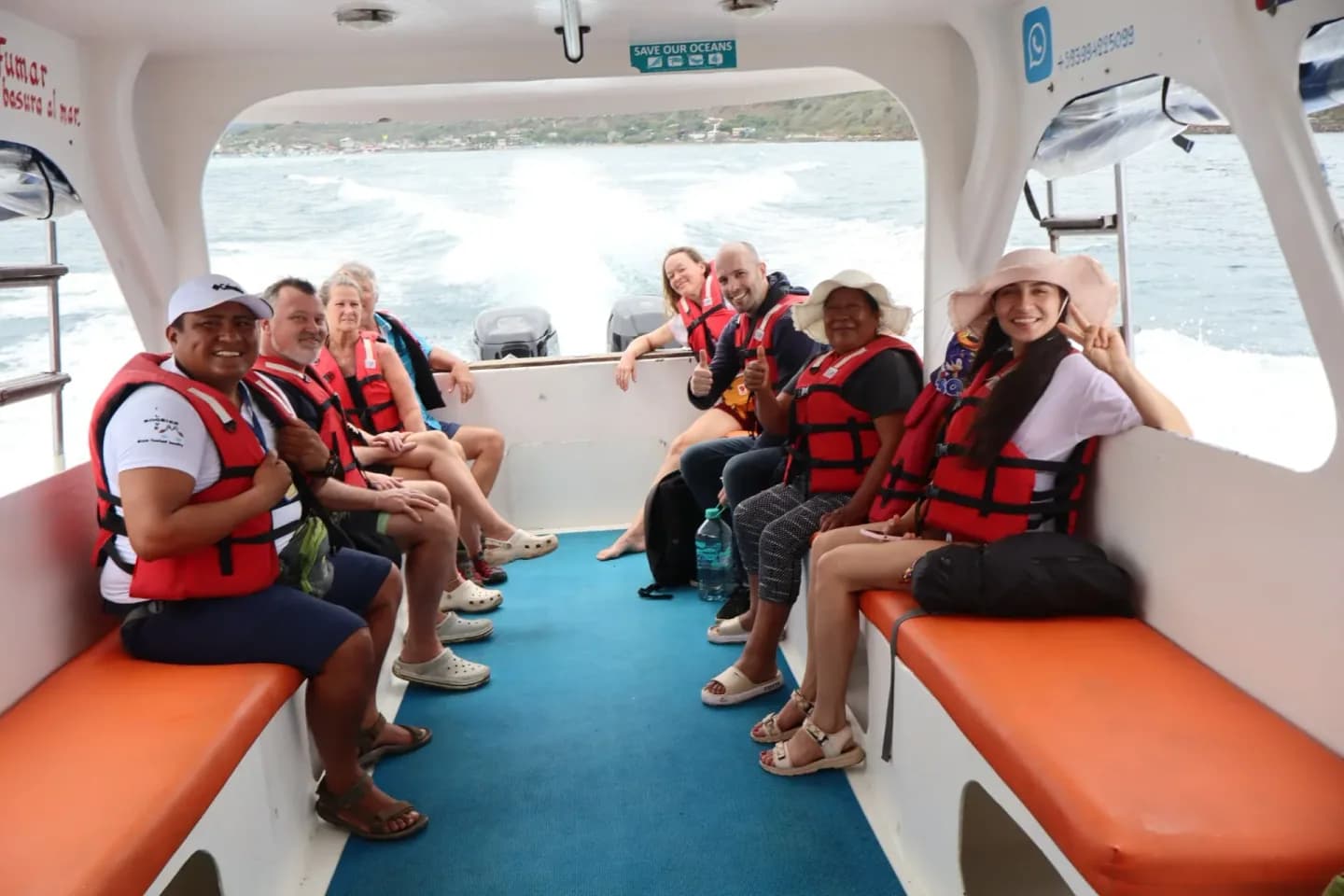
Isla de la Plata: a boat day trip to see birds up close and snorkel over bright, colorful fish.
Jungle hike: a walk into the dense green jungle behind Puerto Lopez, alive with monkeys, birds and a huge, exotic biodiversity.
Free days: time to relax in Puerto Lopez, on the beach and around the town. That is one free day on the 5-day trip, three on the 7-day and six on the 10-day. Browse all Coast Region tours to compare.
I know these trips are limited to Puerto Lopez. What about the other coast region spots? Due to safety reasons, other locations are not actively offered. More about this in the safety section.
8. What a coast trip costs
This is one of the most affordable regions in Ecuador. Your money goes on a hotel, food and trips with tour guides. Beach walks and swimming in the ocean are for free.
I see travel budget to vary depending mostly on personal preferences. Budget traveling goes between USD 40 to 80 a day per person. This includes for example beach hostels, set-menu for the lunch and group guided tours. Mid-range is about USD 80 to 160 a day (comfortable beach hotels, island and jungle day trips and taxis). Comfort level runs USD 160 to 350 a day (luxurious beach resorts, a driver and tour guide).
A typical week on the coast therefore lands around USD 600 to 1,200 per person on the ground, before flights. The good news: the beaches are free, and there are no Galapagos park fees. Only Machalilla National Park and its Isla de la Plata boat trip require a contribution.
9. About the coast region: food
Seafood is the whole point here, and it is some of the best in Ecuador. It is fresh, simple and affordable. Here are the dishes to order first.
Ask any Ecuadorian where the food is best, and most will say the coast.
Ceviche is the local favorite cold dish. This fresh dish with fish or shrimp, "cooked" in lime juice with onion, tomato and cilantro gives you a great start with new energy. The cold dish goes really well during hot days. Even people who don't like shrimps, are generally impressed by this blend of flavors.
Encebollado should be on your bucket list. Especially after a night of drinking a few beers. The healthy mix of ingredients give you new energy for a great start of the new day. It is a hot soup of fish, yuca and pickled onion, eaten any time.
Encocado is fish or shrimp in a rich coconut sauce combined with bolon de verde. Bolon de verde is a ball of mashed green plantain with cheese, pork or vegetables inside. Taste local quality
10. About the coast region: history overview
People have thrived on this shore for generations. The coast holds some of the oldest cultures in the Americas. History comes alive in its museums and old towns.
Around 3500 BCE, the Valdivia culture flourished here. It was one of the oldest pottery-making societies in the Americas. These potteries are famous for their little clay figurines. Much later, the Manteno were skilled seafarers who traded up and down the Pacific on great balsa-wood rafts.
In 1538 the Spanish founded Santiago de Guayaquil, which grew into the country's great port. Nearly three centuries later, on 9 October 1820, Guayaquil declared its independence, a date the city still celebrates.
The modern chapter is written about tourism. Since the late 1900s, beach tourism and whale-watching along the Ruta del Sol have made the coast one of Ecuador's favorite escapes.
11. About the coast region: health and safety
Let's be honest and practical about this, because it matters. Most coast trips are completely trouble-free, but a little local knowledge keeps them that way.
Where is it safe in the coast region? Formal advice is negative to visit the coast region. I speak with many foreign travelers who still explore the whole coast region. They felt safe and enjoyed their coast experience. Based upon personal visits in 2026 I offer trips to secured places like Puerto Lopez.
Having said that, the whole coast region has the status of Think twice before you go. According to the U.S. it has the status "reconsider travel". This does not mean not to go, but to stay aware. You can still enjoy these locations. Keep your guard up after dark and stay inside the town.
Where not to go. A few zones are flagged "do not travel," and the rule there is simple: skip them. They are northern Esmeraldas and the strip up to the Colombian border, south Guayaquil and Duran. Also the border and interior cities of El Oro (Huaquillas, Arenillas) and Los Rios (Quevedo). Simply put, none of them are places a tourist needs to be.
12. About the coast region: money and practical rules
A few simple things smooth out a coast trip. None of them will slow you down, but they are worth knowing before you leave the hotel.
Ecuador uses the US dollar, so there is nothing to exchange. Just carry small bills, because beach towns and buses rarely change a 20. Cards work in cities; cash rules on the sand.
The beaches are free, and only Machalilla National Park charges a small fee. Tip around 10% at restaurants.
Finally, treat the fishing communities with care. Buy from local vendors, and ask before you photograph people at work.
13. Packing essentials for the coast
You can travel light here. The coast forgives almost everything except a bad sunburn. Get these six groups right and you are set.
The idea is light and quick-drying. Breathable t-shirts and shorts, a light sweater for the evening sea breeze, and two sets of swimwear cover most days. Add a packable rain jacket for the wet season from December to May.
The sun is the real hazard: bring reef-safe sunscreen, sunglasses and a brimmed hat. On your feet, sandals plus water shoes handle both soft sand and rocky shores.
Round it out with a beach kit: a dry bag for your phone and cash, a quick-dry towel and maybe a snorkel mask. Add a small daypack with US dollars in small bills and a copy of your passport.
14. The big mistakes first-time visitors make (and how to avoid them)
Almost every coast trip goes smoothly. The few that wobble usually trip over the same handful of things, and each has an easy fix.
After ten years of guiding, the misses I see most are about what's in the bag. There are six of them, each with an easy fix.
- Skipping sun protection. Going without sunscreen, even for a short walk, even under cloud. The equatorial sun burns fast, so use it morning to evening.
- Forgetting a hat. Sunscreen alone is not enough against the midday glare. A brimmed hat and sunglasses are shade you can carry.
- Packing too few clothes. One or two outfits for a humid, sweaty coast. Bring a few light, quick-dry sets you can rinse and re-wear.
- Beachwear into the jungle. Shorts and sandals on the mangrove and dry-forest trails. Cover up inland with light long sleeves, trousers, closed shoes and repellent.
- Bringing no cash. Counting on cards, then hitting cash-only coast towns. Carry US dollars in small bills; big notes are hard to break.
- No insect repellent. Heading inland and into the mangroves with nothing against the bugs. Pack repellent and start using it as you drive down from the Andes, where the air first turns hotter.
15. Frequently asked questions about the Ecuadorian coast
These are the questions first-timers ask me most before a coast trip.
What coast tours within Ecuador does Viaaza offer?
Five Puerto Lopez–based trips: a flexible beach stay plus 4-, 5-, 6- and 7-day tours. All are centered on Isla de la Plata, and coastal jungle. Humpback whales can be seen within the whale season.
Is Isla de la Plata worth it?
It is a day trip from Puerto Lopez where you walk trails past blue-footed boobies and frigatebirds up close. It gives you a Galapagos-style wildlife experience in a single day. It is ideal if you are limited in time and budget. In whale season the boat ride out is a bonus.
Is Ecuador's coast safe to visit?
It is location-specific within the coast region. The U.S. State Department flags higher caution for parts of the coast, including parts of Esmeraldas and Guayaquil. Read the current advisory before you book and again before you travel, and use app-based taxis in cities.
✍️ A personal note from Jonatan
Hello, my name is Jonatan Chimarro. I was born and raised in Quito. Throughout my life I have lived in all regions of Ecuador for shorter or longer periods of time. The beauty of the creation inspired me to enjoy life. I'm proud of our country and like to show its beauty to others. That is how I grew into a passionate tour guide.
I'm a certified tour guide, registered with Ecuador's Tourism Administration (Ministerio de Turismo). My bachelor's education taught me the importance of respect for nature and sustainable business development, and how to be a good guide with many miles of expertise under my belt.
When I'm off work, I like to study and hike. I study birding in which I'm also certified. The colors and sounds of birds are so amazing to me. Hiking long distances in the mountains or the jungle is good to maintain health and physical condition. I like to see new locations, take in new inspiration while I walk and experience encounters with wildlife. Processing my thoughts or having a good conversation along the way is living life in richness and happiness to me.
Follow my company Viaaza or follow me personally on Instagram.
— Jonatan, Quito, 2026
📚 Source list
- https://www.cia.gov/the-world-factbook/countries/ecuador/
- https://ecuador.travel/en/
- https://www.turismo.gob.ec/
- https://www.ambiente.gob.ec/
- https://travel.state.gov/content/travel/en/traveladvisories/traveladvisories/ecuador-travel-advisory.html
- https://wwwnc.cdc.gov/travel/destinations/traveler/none/ecuador
- https://www.bce.fin.ec/
- https://avibase.bsc-eoc.org/checklist.jsp?region=ECmnlp
- http://areasprotegidas.ambiente.gob.ec/en/areas-protegidas/pacoche-marine-wildlife-refuge