
Andes Mountains Travel Guide 2026: Why-What-Where-When to go

By Jonatan Chimarro ·
👋 Hello, I'm Jonatan
I'm a passionate tour guide in Ecuador and author of these blogs. I have lived and worked in all regions of Ecuador: Galapagos Islands, Amazon Rainforest, Andes Mountains and the coast. Quito is my birthplace. With over 10 years of work experience in tourism you can see me as your local expert. (Full bio at the end.)
This Andes Mountains travel guide is for anyone planning a tour. It is mainly for those traveling for the first time, but also if it is your third time. I write about the Andes from what I see with my own eyes. I like to use infographics to make all the important information easy to understand. If you need more information, you are always welcome to contact me. There is also a comment section at the end of this blog in case of questions and suggestions.
⏱️ Andes in 1 minute
The Ecuadorian Andes — the "Avenue of Volcanoes" — pack snow peaks, crater lakes, the equator line, indigenous markets and colonial cities into one north-south strip, most of it a few hours from Quito. The catch is altitude: Quito sits at 9,350 ft (2,850 m), so keep your first day easy while you acclimatize. Here is the whole trip in five lines:
- Why go — The Avenue of Volcanoes, with crater lakes, the equator line and the Andes jungle, all within a few hours of each other.
- What to do — Hiking, soaking in hot springs, bird spotting and a visit to the Otavalo market.
- Where to go — Quito as your base, with Cotopaxi, Mindo and Otavalo all close by.
- When to go — Good all year long, drier June–September and wetter October–May, with four seasons in one day.
- What it costs — Roughly $80–250 a day for your hotel, food and activities, all world-class value.
1. Why visit the Andes Mountains of Ecuador?
The Andes Mountains of Ecuador are called Sierra by local people and the Avenue of Volcanoes by old explorers. It is a strip of mountains and volcanoes running the whole length of Ecuador from north to south. In one short trip you can stand on the equator, touch snow, browse a 400-year-old market and sleep in a colonial city. No other Andean country packs the highlands this tightly.
People visit the Andes Mountains for the volcanoes. They remember small things like the yellow equator line and plates filled with healthy and delicious food.
— Jonatan Chimarro, Ecuador Travel Expert
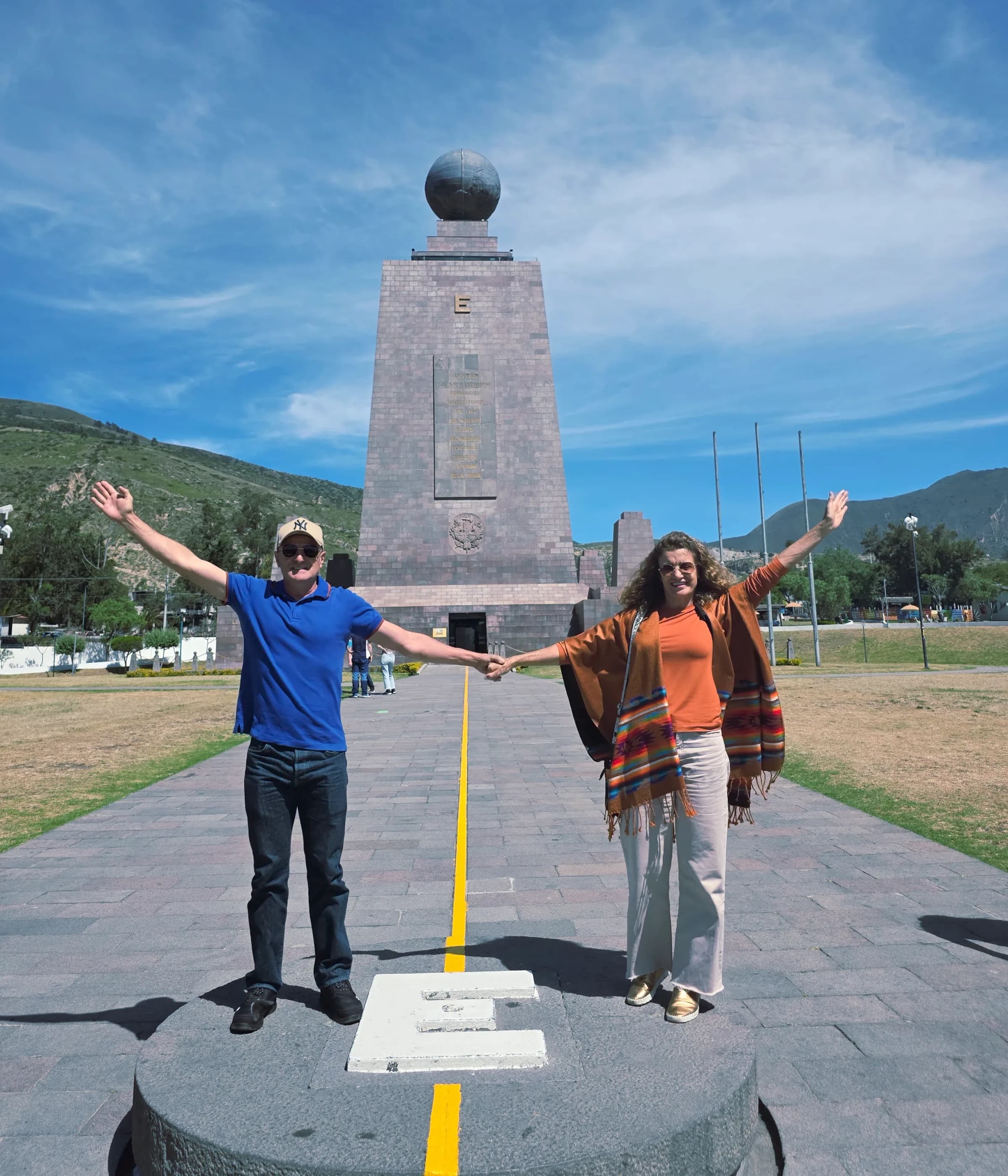
Here you can stand at the equator line and touch snow on the same day. The equator, line 0 degrees, crosses the mountains just north of Quito. Right beside it stands Chimborazo, 20,548 ft (6,263 m) tall. The top of Chimborazo sits closest to the sun, because Earth is a little fatter around its middle.
The Andes also holds two UNESCO World Heritage cities: Quito and Cuenca. Both sites are famous for their colonial old towns. Visit Mindo for its cloud-forest wildlife and go to the famous craft market at Otavalo. Best of all, these places are only hours apart by car.
And the culture is alive. Markets, weaving villages and Kichwa highland towns are part of everyday life here. It's a live show for visitors of how locals live. That mix of big nature and living culture, side by side, is why the Andes stays with people.
2. What are the Andes Mountains of Ecuador?
Before the highlights, here is the big picture. The Ecuadorian Andes are easiest to grasp two ways: as a ladder of altitude you climb from sea level to a snow summit, and as a mountain range seen from above, running the length of the country. This section shows both.
Height is the key to everything here. As you climb, the climate, the plants and the wildlife change band by band. Down low, the western slope is dripping green cloud forest. The cities and farms sit in the interandean valley (Quito is at 9,350 ft / 2,850 m). Above the tree line spreads the golden paramo grassland, and above that, bare rock and the glaciers of the big volcanoes. The highest volcano is Chimborazo at 20,548 ft (6,263 m). Chimborazo is also the highest point in Ecuador and the spot on Earth closest to the sun.
This is also why the locals say you get "four seasons in one day," and why the smart trip eases in, then goes high. You fly straight into altitude at Quito, so you adjust there first and save the big peaks for after - dropping back down to Mindo or Banos is never the problem. A rule you'll meet again in the altitude section to help you get accustomed to the altitude.
Seen from above, mainland Ecuador has 3 regions: the Pacific coast in the west, the Amazon in the east, and the Andes down the middle. The Andes are really two parallel ranges - the Western and Eastern Cordilleras - with a high interandean valley between them, running the whole length of the country from north to south. The equator crosses the range just at Quito. Nearly every place in this guide sits in or beside that central valley, which is why the highlights are only hours apart by road.
3. Popular travel locations in the Andes
The best of the Andes lines up along one north-south corridor. The map sorts every destination into three groups: a cultural north, a volcanic center, and a colonial south - all within a few hours of Quito.
What each spot is known for
Here are my reasons why each of the 19 spots on the map are worth visiting. The numbers below relate to the numbers in the infographic.
North
- 1. Otavalo holds the most famous indigenous craft market in the Andes, at its biggest on Saturdays. Nearby are the Peguche waterfall and the Cuicocha crater lake.
- 2. Cotacachi is the leather town, lined with workshops selling handmade jackets, bags and belts, below the Cotacachi volcano.
- 3. Mindo is a cloud-forest town on the green western slope, one of the best birding spots on Earth, with waterfalls, ziplines and chocolate tours.
- 4. Peguche is a weaving village where families still make Andean textiles on backstrap looms, beside the sacred Peguche waterfall.
- 5. San Antonio de Ibarra is the woodcarving town, full of galleries showing hand-carved wooden sculpture.
- 6. Cayambe sits under its snow-capped volcano, the only snow on the equator, and is known for bizcochos, crunchy biscuits eaten with cheese.
Central
- 7. Quito is the capital and the usual starting point, with a UNESCO colonial old town and the equator monument just north of the city.
- 8. Cotopaxi is one of the world's highest active volcanoes, a near-perfect snow cone in a national park of paramo grassland, hikes and guided glacier climbs.
- 9. Chimborazo is Ecuador's highest peak at 20,548 ft (6,263 m), and its summit is the point on Earth closest to the sun; wild vicunas roam the reserve.
- 10. Quilotoa is a turquoise crater lake filling a volcanic caldera. The rim viewpoint and the steep hike down to the water are the draw.
- 11. Banos is the adventure hub: waterfalls, hot springs, rafting, canyoning and the downhill bike route known as the Ruta de las Cascadas.
- 12. Papallacta is a set of high hot springs east of Quito, with thermal pools looking out over paramo on the road toward the Amazon.
- 13. Antisana is a glaciated volcano and ecological reserve, one of the best places in Ecuador to see the Andean condor over wild paramo.
South
- 14. Cuenca is the southern jewel: a UNESCO colonial city of cobbled streets, a blue-domed cathedral and Panama-hat workshops.
- 15. Ingapirca is Ecuador's largest Inca site, built around the elliptical Temple of the Sun in fine Canari and Inca stonework.
- 16. El Cajas is a national park of paramo and hundreds of glacial lakes west of Cuenca, good for day hikes and trout fishing.
- 17. Vilcabamba is a warm, laid-back village known as the Valley of Longevity, popular for hiking and horseback riding.
- 18. Gualaceo and Chordeleg are craft towns near Cuenca: Gualaceo for its riverside weekend market, Chordeleg for silver and gold filigree jewelry.
- 19. Loja is a southern city of music and gardens, the gateway to Podocarpus National Park and the road down to Vilcabamba.
4. What to do in the Andes: activities by location
The Andes reward doers. What you can do depends less on the calendar and more on where you like to go. The matrix combines each activity with the places it's available.
What each activity is like
Here is what each activity involves, and where in the Andes it shines.
- Hiking is everywhere. Try the paramo at Cotopaxi and El Cajas, the crater rim at Quilotoa, or easy town walks. Take the altitude slowly.
- Snow climbing is only on the icy peaks of Cotopaxi and Chimborazo. It is tough. You need a guide and gear.
- Mountain biking is best at Cotopaxi. You can also ride at Quilotoa and near the Banos waterfalls.
- Rafting is at Banos. It is the place for white-water on rivers toward the Amazon.
- Wildlife and birding are best at Mindo, Cotopaxi, Chimborazo, El Cajas and Papallacta. Look for condors, vicunas and hummingbirds.
- Markets and crafts are best in Otavalo and Cuenca. Otavalo has the biggest craft market. Cuenca is famous for Panama hats. Quilotoa has a little market at the crater rim too, handy for local crafts and snacks.
- Hot springs are at Banos and Papallacta. The warm pools are great for tired legs.
5. Which wildlife will you see, and where?
The Andes are not the Galapagos, but the wildlife is real and wild. Where you go decides what you meet. The matrix maps each animal to the habitat where you have a good chance to see them.
From Quito down to Mindo, the parks and forest hum. Spot colibries between the flowers like tiny sparks. They vanish before you blink.
— Jonatan Chimarro, Ecuador Travel Expert
What you might see, and where
Here is each animal and plant, and where you have a good chance to see it.
- Andean condor is Ecuador's national bird and one of the biggest flying birds on Earth. Look up over the paramo and high peaks like Cotopaxi and Antisana, and above El Cajas.
- Andean bear is South America's only bear. It is shy and hard to spot. It lives in the cloud forest and paramo edges.
- Llamas and alpacas are the classic Andean pack animals. You see them in the paramo and around the highland towns and farms.
- Vicuna is the wild cousin of the alpaca. It roams the high paramo and peaks, mostly around Chimborazo.
- Hummingbirds come in more than 130 kinds here. Mindo's cloud forest and town gardens are the best places to see them.
- Paramo plants are the spongy grassland and the Polylepis, the highest woodland on Earth. They grow in the paramo, high peaks and around the Cajas lakes.
6. When to visit the Andes Mountains
First-timers want a "best month." The honest answer is that the Andes are good all year, but the seasons and the festival calendar have clear dates worth planning around.
First-timers want a "best month." The honest answer: the Andes are good all year, but the seasons have a clear shape.
The drier season runs roughly June to September. Trails are firmer, and the high peaks show themselves more often. The wetter season, October to May, brings more cloud and afternoon rain, but also green hills and fewer visitors.
Whatever the month, pack for the daily cycle. In the Andes the locals say you get "four seasons in one day." A morning can start cold, turn hot and bright by ten, cloud over by two, and rain by four. Layers of clothing are needed.
Then there are the festivals, and they can shape your dates. Carnaval in February is water, foam and color, and Ambato throws its Flores y Frutas flower-and-fruit parade at the same time. On May 24, the Batalla de Pichincha marks the day Ecuador won its freedom. June is the big month, with Inti Raymi, Corpus Christi and San Juan filling the highland towns with dancers and bonfires. In September, Otavalo celebrates the corn harvest at Yamor. Then come the independence parties: Guayaquil in October, Cuenca in November, and the Fiestas de Quito in December. A festival turns a good trip into a story.
7. Examples of Andes Mountains tours
To make it concrete, here are three popular tour examples within the Andes Mountains. Notice that every tour starts off easy in Quito before you go high. This is the golden rule of a smart and safe trip: you land at altitude in Quito, adjust over the first day or two, then tackle the heights. Going back down to Mindo or Banos is easy and even helps you recover.
Here are examples of what tours in the Andes Mountains can look like. Browse all Andes Mountains tours.
5 days: Quito (easy first days), the Middle of the World, and Mindo.
7 days: Quito, then Mindo, then Cotopaxi, then Banos. Enough time to settle into the rhythm without rushing.
10 days: everything above, plus Cuenca and Ingapirca in the south, and a stop in Otavalo.
8. What an Andes trip costs
If you ask me, the Andes offer triple-A attractions at outstanding value: UNESCO sites, the equator line, volcanoes, cloud forest and exotic wildlife.
Your daily spend is mostly hotel, food and activities. Depending on your comfort preferences and scheduled activities, your daily spend varies between USD 80-450 a day. Unlike the Galapagos, there is no big entry fee.
As a planning guide, budget travel runs about USD 80-130 a day per person. This includes simple hotels, public transport, basic meals, group trip with a tour guide.
Mid-range budget is about USD 130-250 a day. This includes more comfortable hotels, taxi, public transport, and a private tour guide.
Comfort level is about USD 250-450 a day. This includes historic hacienda stays, a private driver and private tours. This offers maximum flexibility and traveling at your own pace.
A typical 7-day mid-range trip is therefore between USD 1,000-1,700 per person.
9. About the Andes: a short history
The story of these mountains is written in their towns. You see terraced fields, an Inca temple, colonial churches and independence squares. Each place has its own story - and you can walk right through it.
Long before the Inca, the Canari and other peoples lived here. They farmed and terraced these valleys. Around 1470 the Inca arrived from the south. They built Ingapirca, still the best Inca site in Ecuador.
In 1534 the Spanish founded Quito. They built it on the ruins of an Inca city. Its old town is a UNESCO site today. In 1822, Marshal Sucre won the Battle of Pichincha above Quito. Colonial rule ended.
Then came recognition. UNESCO listed Quito's old town in 1978. Cuenca's followed in 1999. Both are among the best-kept colonial old towns in the Americas.
10. About the Andes: health, altitude and safety
Altitude matters more than distance here. It is easy to manage once you understand it. The rule is simple: ease in, then go high. You land high at Quito, so rest there first. Save the big volcanoes for after your body adjusts. Dropping down to Mindo or Banos is never a problem.
Altitude is not a wall, it is a speed limit. Go slowly for two days and the mountains open up. Rush them, and you spend your holiday with a headache.
— Jonatan Chimarro, Ecuador Travel Expert
I know quite a few tourists, mostly of younger age, who preferred to drink a cold beer in order to get used to the altitude. Especially for those, I do recommend however, to read this section twice.
Most first-time travelers fly straight into Quito. Quito is high: 9,350 ft (2,850 m). That is already higher than the point where the CDC says to start being careful. Their rule of thumb: do not go from low ground to a sleeping height above about 9,022 ft (2,750 m) in one day if you can help it. Spend 2–3 nights getting used to the height before you climb further.
Altitude sickness is possible. If it happens, it usually stays mild. The signs are a headache, tiredness, poor sleep, no appetite, a little dizziness.
Here is my practical advice for tourists who just arrived in Quito:
- 🟢 Easy is below the care line (under 9,022 ft / 2,750 m). Most towns in the Andes sit here, so take your first day slow: walk the old town and drink water. According to the doctor, skip alcohol for a day or two.
- 🟡 Take care is past the care line (9,022–11,483 ft / 2,750–3,500 m), where Quito itself sits. Give your body 2–3 nights to adjust before climbing higher, and take a break to catch your breath during everyday activities.
- 🟠 Go slow means very high (11,483–15,748 ft / 3,500–4,800 m). Climb high, sleep low: a day trip up is fine, but sleep lower, and gain height gradually.
- 🔴 Guided only means serious altitude (above 15,748 ft / 4,800 m). Cotopaxi and Chimborazo are for guided climbs with full acclimatization. If symptoms get worse, do not go higher, but go down; descending is the cure.
Whatever your altitude, ask your doctor about acetazolamide, a medicine that speeds acclimatization.
11. About the Andes: money, park entry and rules
The practical rules are simple and good to read once. This will help your tours go smooth and prevent surprises.
Ecuador uses the US dollar, so there is no currency to exchange. Just carry small bills and coins, because people rarely change a 20. People still use cents to pay. Cards work in cities. Cash rules in the countryside.
Park entry means modest national-park fees, far below the Galapagos. Tip around 10% at restaurants and a few dollars a day for guides and drivers.
The rules that matter are about respect. Stay on the marked trails in the fragile paramo. Ask before you photograph people. Treat community land and market vendors with care. For safety, use registered or app-based taxis in Quito. Take normal care at night. Check your government's Ecuador travel advisory before you go.
12. Food in the Andes Mountains
Highland food is hearty, warming and built for altitude. Some of it is adventurous, some of it is comfort in a bowl - here are four dishes to try.
You eat well in the Andes, and you eat to stay warm.
Locro de papa is the dish to start with. It's a thick, creamy potato soup with cheese and avocado. It is comfort in a bowl and it is everywhere. Tasty and healthy!
For a bigger meal, look for hornado: a whole pig, slow-roasted, served with corn and potato. It is a market-day and Sunday food. Llapingachos is fried potato-and-cheese patties. It often comes on the side.
Cuy, or guinea pig, is local cuisine and a delicacy. It is a real, old highland dish, eaten on special days or moments. Try it if you are curious. The meat is lean, like chicken.
To drink, there is canelazo. This is hot water with cinnamon, sugar cane, and a splash of alcohol. On a cold mountain night, it is the perfect thing.
13. Packing essentials for the Andes
Pack for "four seasons in one day," plus the surprisingly strong sun at altitude. Know these 6 topics and you are ready for almost anything in the Andes Mountains.
The core idea is layers. Bring a fleece or light down mid-layer. Add a warm hat and gloves, and a few t-shirts. That covers you from a cold dawn to a bright noon. On top, a waterproof shell handles the afternoon rain.
At this altitude the sun is fierce, even when it feels cool. Bring high-SPF sunscreen, real sunglasses and a brimmed or wool hat. For your feet, pack broken-in walking shoes with grippy soles. New boots slip on muddy paramo trails.
Round it out with a small health kit. Pack a reusable water bottle, any altitude medicine your doctor advises, basic first aid and hand gel. Add a daypack with US dollars in small bills and a copy of your passport.
14. The big mistakes first-time visitors make (and how to avoid them)
Most first Andes trips go well. Tourists usually stumble during a trip over the same 3 things. The good news is: each stumbling block has a simple fix.
After ten years of guiding the Andes, I see the same three mistakes again and again.
- Ignoring altitude. Travelers land in Quito and climb a volcano the next morning. Then they lose two days to a headache. Take the first day easy.
- Packing for one kind of weather. The Andes give you "four seasons in one day." Without layers, you are cold by morning and wet by afternoon.
- Only seeing Quito. Quito is wonderful, but it is the door to more. Jungle, volcanoes, biodiversity give real value for a special trip.
15. Frequently asked questions about the Ecuadorian Andes
These are the questions first-timers ask me most before an Andes trip.
How far is Quito's airport from the city?
About 45 minutes to an hour from central Quito.
Do I need to be fit to visit the Andes Mountains?
Normal health condition do just fine. You can enjoy the Ecuadorian Andes without climbing anything. Quito's old town, the equator line, the Otavalo market, Cuenca, the cloud forests and the lower volcano viewpoints are all gentle. Climbing Cotopaxi or Chimborazo to the summit is a serious effort for trained mountaineers only.
Can I combine the Andes with other parts of Ecuador?
Yes, easily, that is one of Ecuador's strengths. The Andes can be naturally combined with the Amazon Rainforest and with the Galapagos Islands by plane. A classic car trip is also possible to the coast region and the Amazon.
✍️ A personal note from Jonatan
Hello, my name is Jonatan Chimarro. I was born and raised in Quito. Throughout my life I have lived in all regions of Ecuador for shorter or longer periods of time. The beauty of the creation inspired me to enjoy life. I'm proud of our country and like to show its beauty to others. That is how I grew into a passionate tour guide.
I'm a certified tour guide, registered with Ecuador's Tourism Administration (Ministerio de Turismo). My bachelor's education taught me the importance of respect for nature and sustainable business development, and how to be a good guide with many miles of expertise under my belt.
When I'm off work, I like to study and hike. I study birding in which I'm also certified. The colors and sounds of birds are so amazing to me. Hiking long distances in the mountains or the jungle is good to maintain health and physical condition. I like to see new locations, take in new inspiration while I walk and experience encounters with wildlife. Processing my thoughts or having a good conversation along the way is living life in richness and happiness to me.
Follow my company Viaaza or follow me personally on Instagram.
— Jonatan, Quito, 2026
📚 Source list
- https://www.cia.gov/the-world-factbook/countries/ecuador/
- https://ecuador.travel/en/
- https://www.turismo.gob.ec/
- https://www.cdc.gov/yellow-book/hcp/environmental-hazards-risks/high-altitude-travel-and-altitude-illness.html
- https://wwwnc.cdc.gov/travel/destinations/traveler/none/ecuador
- https://whc.unesco.org/en/list/2
- https://whc.unesco.org/en/list/863
- https://travel.state.gov/content/travel/en/traveladvisories/traveladvisories/ecuador-travel-advisory.html
- https://www.bce.fin.ec/